



Jacques Selosse Rosé & V.O. | Two Expressions of Chardonnay
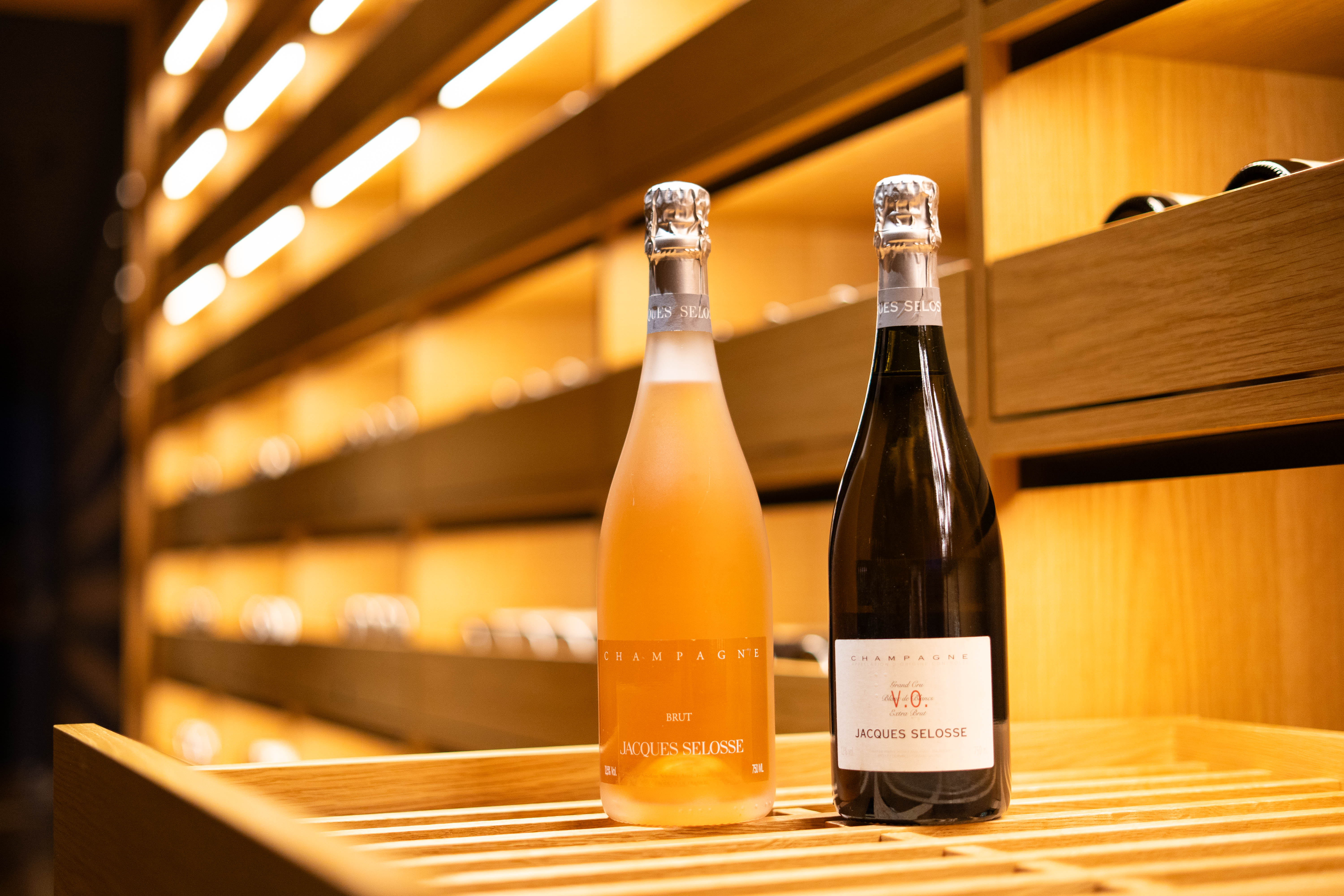
On the left is Jacques Selosse Brut Rosé. On the right, V.O. Version Originale.
A pale rosé hue beside a deep golden tone.
They look very different, yet Chardonnay lies at the heart of both wines.
The Rosé broadens its expression with a small addition of Pinot Noir.
V.O. relies on Chardonnay alone to reveal the contours of vineyard and maturation.
The same producer and the same starting grape, moving in two different directions.
Rosé, with Chardonnay Still at the Centre
Rosé Champagne may naturally bring Pinot Noir to mind.
Yet Jacques Selosse Rosé is made primarily from Chardonnay.
To that is added Pinot Noir grown in Ambonnay, one of Champagne’s Grand Cru villages.
The proportion may be small, but its presence adds another layer not only to the colour, but also to the wine’s aroma and flavour profile.
The tension of Chardonnay, recalling white flowers and citrus, is joined by nuances of red fruit.
Rather than pushing Chardonnay into the background to make a rosé, Pinot Noir is used to expand what Chardonnay can express.
Seen that way, the character of this Rosé begins to look a little different.
How Far Can V.O. Go with Chardonnay Alone?
By contrast, V.O. — Version Originale is a 100% Chardonnay Blanc de Blancs.
It is made from Chardonnay grown in the Grand Cru villages of Avize, Cramant and Oger in the Côte des Blancs, and finished as an Extra Brut.
V.O. stands for Version Originale.
The name suggests something close to an “original form” or “essential version.”
No second grape variety is introduced. Instead, the focus remains on Chardonnay, place, time in barrel and ageing in bottle.
The aim is to show what those elements create with as little interference as possible.
In contrast to the Rosé, V.O. draws attention less to what is added than to what is left in place.
Rosé Adds; V.O. Refines
Placed side by side, the appeal of Jacques Selosse becomes easier to see.
In the Rosé, Pinot Noir is layered onto Chardonnay.
In V.O., Chardonnay stands alone, finished with a very low dosage.
One creates breadth by adding another element. The other sharpens its outline by narrowing the composition.
Yet their intentions are not so far apart.
Neither begins with a predetermined idea of what Champagne should taste like. Instead, both ask how wine born from grape and vineyard can be expressed as a single Champagne.
What Becomes Visible When the Two Are Side by Side
Each bottle is a complete Champagne in its own right.
But when the two are placed next to each other, another way of experiencing them emerges.
How does the same Chardonnay change when Pinot Noir is introduced?
What remains when the wine is built from Chardonnay alone?
Colour, aroma, texture and finish.
Following those differences eventually reveals something more interesting than deciding which of the two is better: the range of expression Jacques Selosse draws from Chardonnay.
That is what makes seeing these two wines together worthwhile.
Jacques Selosse Brut Rosé / V.O. Version Originale
Champagne, France | Champagne | 750ml
Left: Jacques Selosse Brut Rosé
Right: Jacques Selosse V.O. Version Originale Extra Brut Blanc de Blancs
For pricing, current availability, and purchase enquiries, please feel free to contact us.
New arrivals are announced on our official Instagram @imami__japan and in our NEWS archive.

