



Edo Kiriko Sake Glass “Asanoha-maki” | A Flowing Pattern Inspired by Kimono
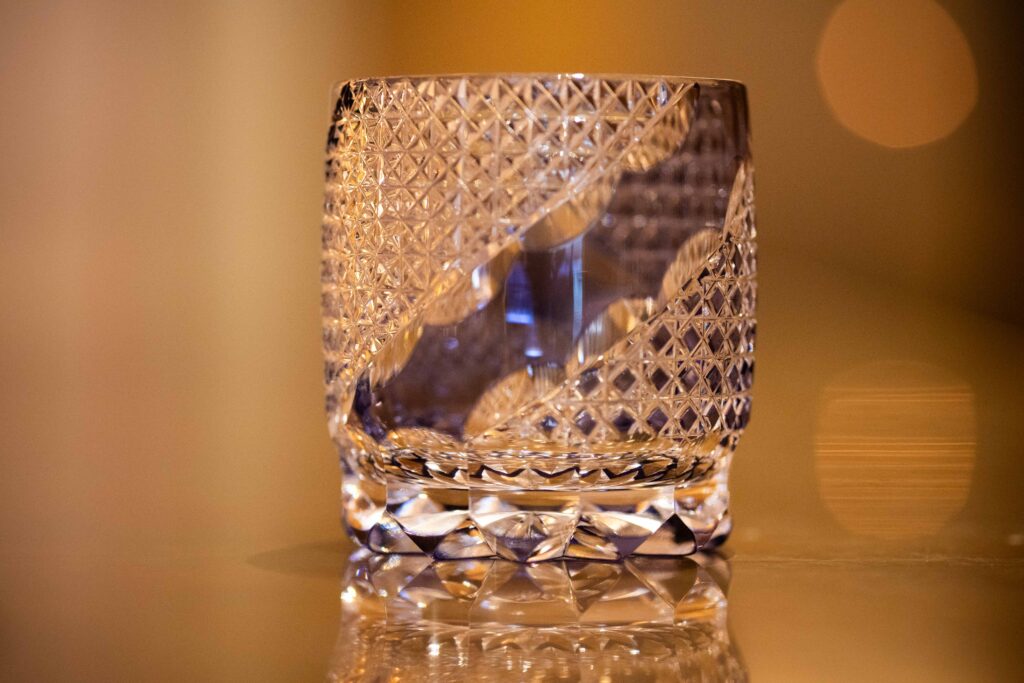
Traditional Edo Kiriko patterns sweep diagonally across the glass, almost as if a piece of fabric had been wrapped around it.
“Asanoha-maki” by Shinozaki Glass Crafts is not a design that simply repeats a traditional motif in perfect order.
Its inspiration comes from the patterns of Japanese kimono.
Originally conceived by the workshop’s founder, Seiichi Shinozaki, the design has been passed down through generations and remains one of the studio’s distinctive expressions of Edo Kiriko.
A Pattern Born from Kimono
The name Asanoha refers to the traditional Japanese hemp-leaf pattern, a geometric motif that has appeared in Japanese textiles and decorative arts for centuries.
In Asanoha-maki, however, the glass is not covered with the hemp-leaf pattern alone.
Two traditional Edo Kiriko motifs — Asanoha and Shikaku Kagome, or square basket-weave — are arranged around a larger, flowing composition.
Fine geometric cuts sit beside broad areas of clear glass.
As the glass is turned in the hand, the balance between pattern, transparency and light continually changes.
Rather than transferring a flat textile pattern directly onto glass, the design takes advantage of the vessel’s three-dimensional form.
The word maki, meaning “to wrap,” captures that sense of movement particularly well.
What Is Cut — and What Is Left Untouched
Edo Kiriko is often associated with glasses covered almost entirely in intricate cutting.
Asanoha-maki takes a different approach.
Large areas of clear glass are deliberately left untouched.
Finely cut Asanoha.
Precise Shikaku Kagome.
Then areas with no cutting at all.
A bold sweeping cut moves between them.
Instead of decorating every surface, the uncut glass becomes part of the design itself.
Once sake is poured, the colour of the drink appears through those transparent areas, while the surrounding cuts catch and scatter the light.
Shinozaki Glass Crafts, Across Generations
Shinozaki Glass Crafts was established in Tokyo in 1957 as a workshop specialising in Edo Kiriko.
Its techniques and designs have been passed from founder Seiichi Shinozaki to the next generations, while the studio continues to combine traditional patterns with original compositions.
The workshop also places particular importance on the glass itself, using crystal glass from Kagami Crystal.
Its clarity allows the fine cuts to reflect light across multiple surfaces, giving the patterns a sense of depth that changes depending on the angle of view.
Asanoha-maki is one of the designs that most clearly carries the studio’s lineage: an idea created by the first generation and still being made today.
A Glass That Changes Once It Is Filled
The sake glass measures approximately 59 mm in diameter and 67 mm in height, with a capacity of around 120 ml.
It is larger than a small sake cup, yet more compact than a typical whisky tumbler.
That makes it suitable not only for sake, but also for enjoying smaller pours of whisky, shochu and other spirits.
Yet the appearance of the glass changes considerably once something is poured into it.
The drink’s colour becomes visible through the untouched sections, while the surrounding cut patterns begin to reflect the light around them.
Asanoha-maki reveals another expression only when it is actually used.
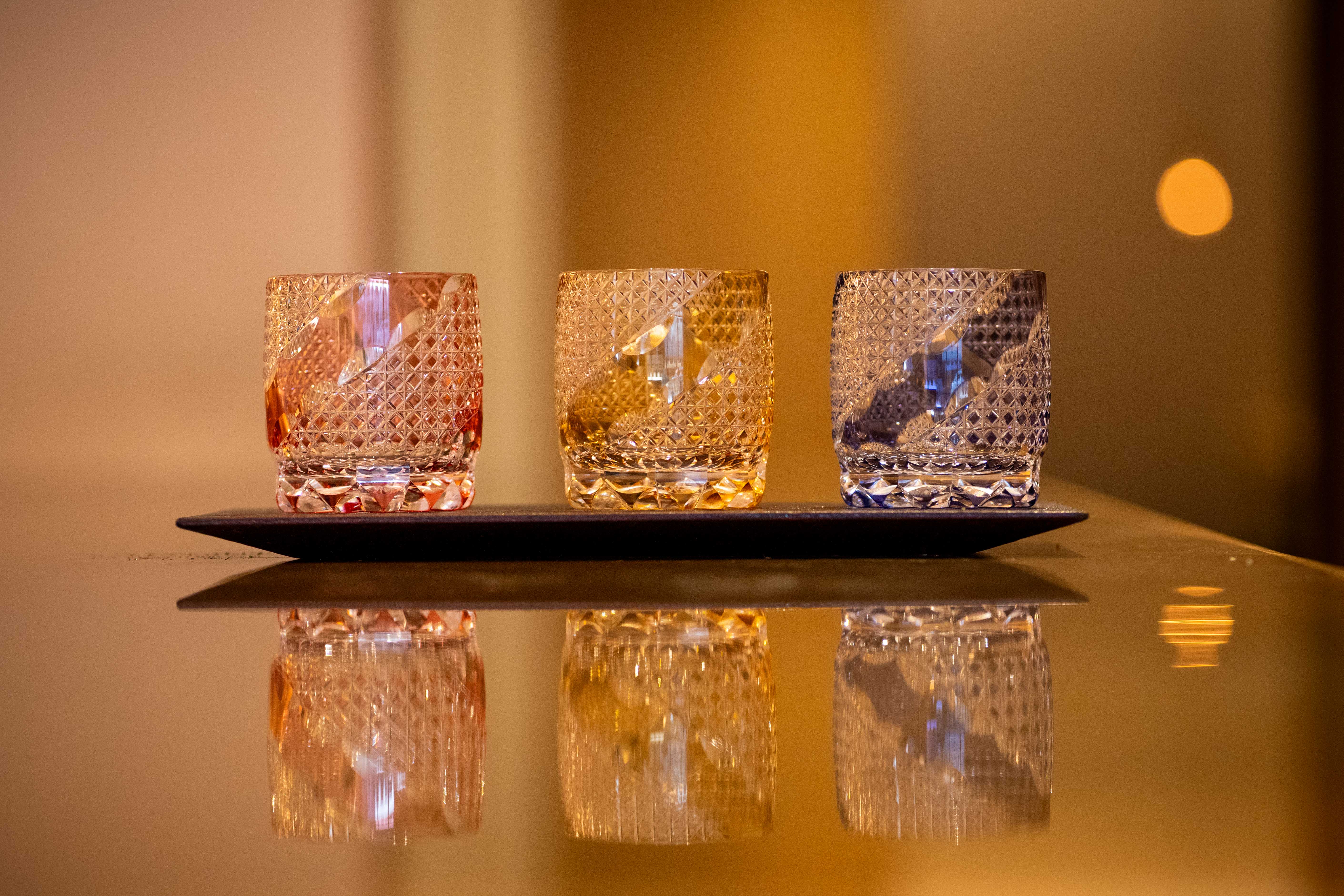
In the photograph, three different colours are shown together.
The cutting pattern is the same, yet each colour changes the softness of the light and the way the details appear.
Choosing a single colour is one pleasure.
Seeing several side by side is another.
Shinozaki Glass Crafts “Asanoha-maki” Sake Glass
Tokyo, Japan | Edo Kiriko | Sake Glass | Approx. 120 ml
An Edo Kiriko sake glass inspired by kimono design, combining the traditional Asanoha and Shikaku Kagome patterns in a flowing composition.
For pricing, current availability, and purchase enquiries, please feel free to contact us.
New arrivals are announced on our official Instagram @imami__japan and in our NEWS archive.

