



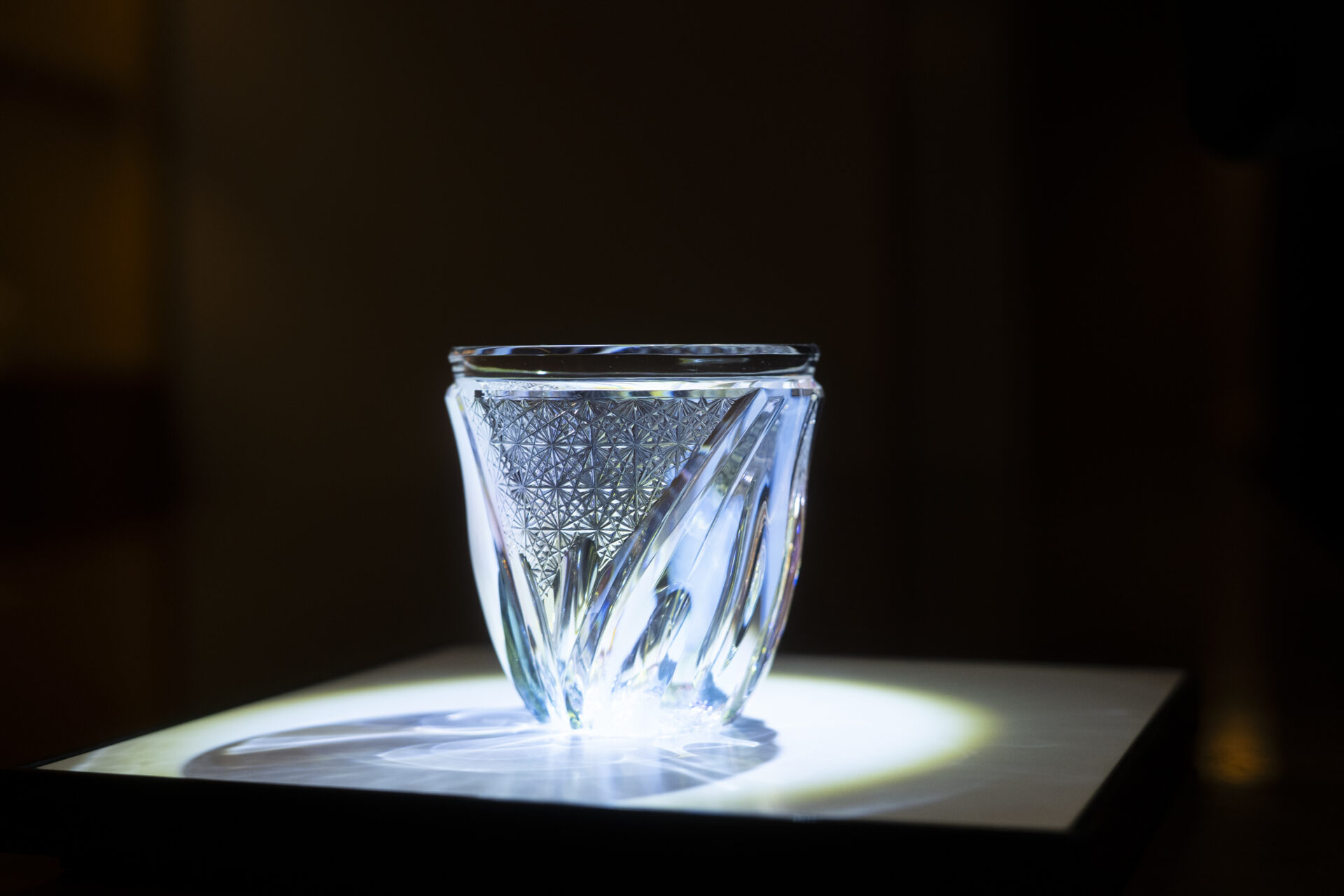
Kohei Kobayashi Uno glass “Saiun 8078” | Edo Kiriko Formed by Gravity
The glass vessel itself is made by the same artisan before the cutting even begins.
Kobayashi Glass Workshop’s Uno glass “Saiun 8078” is a one-of-a-kind Edo Kiriko work by fourth-generation artisan Kohei Kobayashi, made using his original technique known as sagging kiriko.
A sheet of glass is softened in an electric kiln and allowed to fall under gravity to form the vessel. Only after the glass body has taken shape is the surface cut and finished as a piece of Edo Kiriko.
Uno begins before the cutting stage
Much of the visual identity of Uno comes from one unusual choice: Kohei Kobayashi makes the glass body itself, rather than beginning only with a pre-formed vessel.
The technique starts with sagging, a kiln-forming process in which a sheet of glass is placed above a circular opening and heated until it softens.
As the glass becomes flexible, gravity pulls it through the opening. No mould is placed underneath to force the final shape.
Temperature control is critical. Too little heat and the glass will not fall far enough; too much and it can sag beyond the intended form.
What “sagging kiriko” means
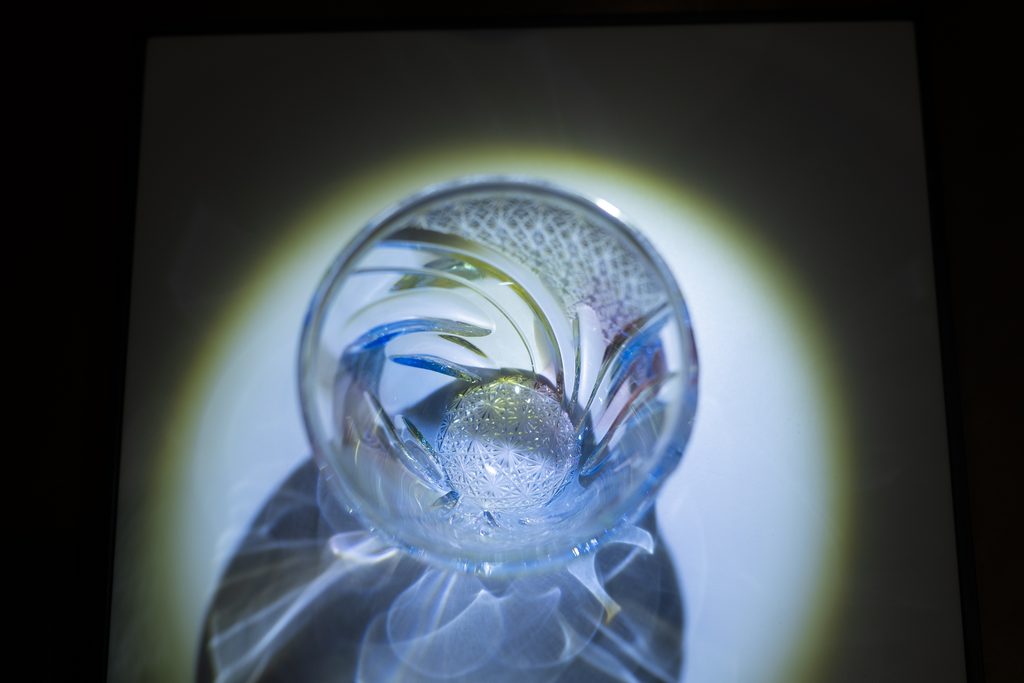
Kobayashi combines this kiln-forming method with the cutting techniques of Edo Kiriko and calls the result sagging kiriko.
For readers unfamiliar with Edo Kiriko, it is a traditional Japanese cut-glass craft associated with Tokyo. Patterns and facets are created by grinding and cutting the surface of glass, then refining and polishing the cuts.
In Uno, precise cutting is applied to a vessel whose outline has already been shaped by heat and gravity. The controlled geometry of the cuts therefore meets the slight irregularity of a hand-formed glass body.
Each piece takes several days to about a week to complete and is made as a one-off work rather than a perfectly repeatable mass-produced form.
“Saiun” means an iridescent cloud
Saiun (彩雲) is the Japanese term for an iridescent cloud — a natural phenomenon in which part of a cloud appears softly rainbow-coloured.
The effect occurs when sunlight is bent and scattered as it passes through tiny droplets or particles in the cloud.
In the Uno “Saiun” works, several colours of glass are combined so that refraction creates shifting colour depending on the viewing angle.
The colour is therefore not simply painted onto the surface. It exists within the glass itself and becomes visible through transmitted and refracted light.
What the number “8078” tells you
The numbers used in Uno glass names are not arbitrary model codes.
Kobayashi Glass Workshop uses them to record the height and rim diameter of the individual vessel in millimetres.
“8078” therefore indicates a piece measuring approximately 80mm high with a 78mm rim diameter.
For a series in which every glass is individually formed, the name acts almost like a record of that specific object rather than a conventional mass-production product number.
Four generations of Edo Kiriko, beginning in 1908
The history of Kobayashi Glass Workshop begins in 1908, when founder Kikuichiro Kobayashi entered an apprenticeship under Edo Kiriko craftsman Tokumatsu Ohashi.
The craft then passed through Hideo Kobayashi and Yoshiro Kobayashi to the fourth generation, Kohei Kobayashi.
Kohei began studying under his father Yoshiro in 2010. His work has since been selected for major Japanese craft and contemporary-glass exhibitions, and he became a full member of the Japan Kogei Association in 2023.
Uno shows how that lineage is being extended rather than simply repeated: traditional cut-glass skills remain at the core, but the making process reaches further back, to the creation of the glass body itself.
Kobayashi Glass Workshop Uno glass “Saiun 8078”
Japan | Edo Kiriko cut glass | Kobayashi Glass Workshop | Kohei Kobayashi | Sagging kiriko | Crystal glass | One-of-a-kind | Approx. 80mm high × 78mm rim diameter
Formed by gravity from heated sheet glass, then cut and polished as Edo Kiriko, Uno “Saiun 8078” combines a one-off vessel shape with shifting colour inspired by an iridescent cloud. The work is made from the glass body onward by a single artisan.
Available at IMAMI
IMAMI is a specialist retailer offering wine, whisky, sake and other fine spirits, together with Japanese drinking vessels including Edo Kiriko glassware. We carefully select and sell each bottle and piece with attention to the craftsmanship, history and culture behind it.
For in-store product availability, please enquire at IMAMI Ginza or IMAMI Shinsaibashi, or contact us.
Product selection and availability vary by store.
New arrivals are announced on our official Instagram @imami__japan and in our NEWS archive.

