

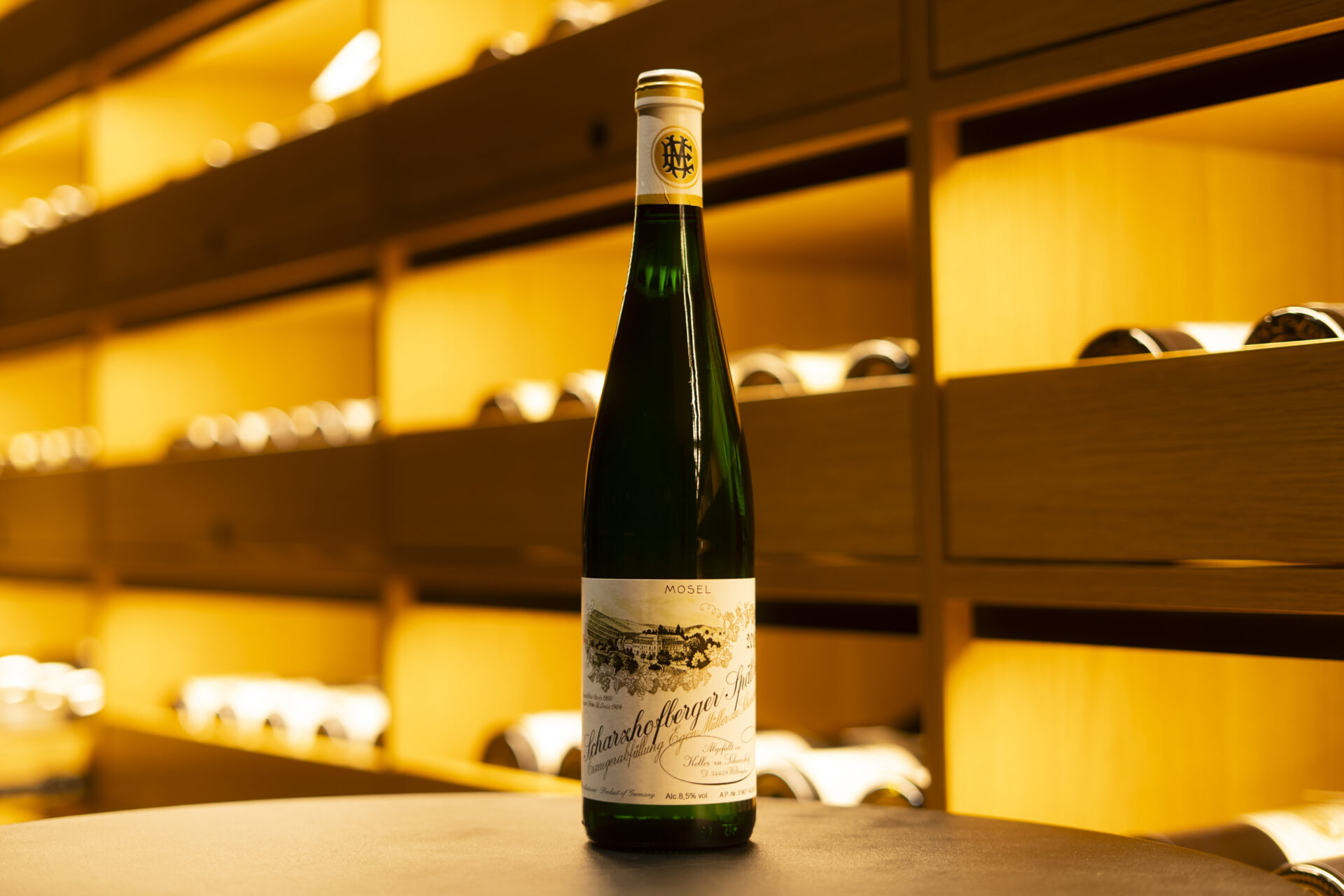
Egon Müller Scharzhofberger Riesling Spätlese | Late Harvest and the Cool Acidity of the Saar
Late-harvest ripeness balanced by the cool acidity of the Saar: a Riesling whose elegance develops beyond sweetness.
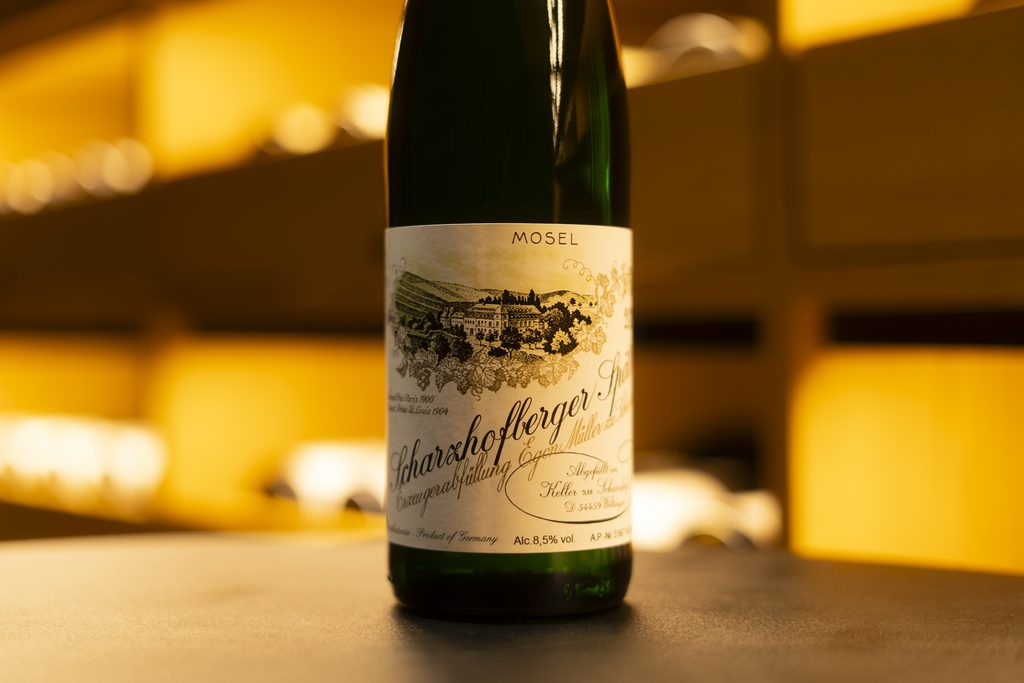
Egon Müller Scharzhofberger Riesling Spätlese is a white wine from the Scharzhofberg vineyard in Germany’s Saar valley, part of the wider Mosel wine region. Egon Müller grows Riesling exclusively, using fruit only from the estate’s own vineyards.
Spätlese means “late harvest” and identifies a Prädikat wine made from riper grapes. At Scharzhofberg, ripe fruit, incisive acidity and the potential for long bottle ageing combine in a style defined by balance rather than sweetness alone.
Egon Müller: The Scharzhof Estate Since 1797
The modern estate traces its roots to 1797, when Jean-Jacques Koch acquired the Scharzhof property. It later entered the Müller family through the marriage of Koch’s daughter Elisabeth to Felix Müller.
The family established an international reputation in the nineteenth century, presenting its Rieslings at world exhibitions and gaining recognition at the Paris exposition of 1900. After World War II, Egon Müller III rebuilt vineyards severely damaged by years of hardship.
Egon Müller IV has led the estate since 1991, continuing its focus on Riesling shaped by the cool climate and distinctive vineyard soils of the Saar.
Scharzhofberg: Slate Soils in One of the Saar’s Coolest Sites
Scharzhofberg is regarded as one of the coolest Riesling vineyards in the Saar. Its south-facing slopes help grapes ripen in a region where warmth cannot be taken for granted.
Slate is central to the vineyard’s geology. Weathered slate allows roots to penetrate the soil, while variations in quartzite add to its complexity. Together with the cool growing conditions, these soils contribute to the distinctive precision and energy of Saar Riesling.
The estate tends vines including some ungrafted plants dating to the nineteenth century. Yields do not exceed 60 hectolitres per hectare and are often around 30. Vineyard work includes frequent cultivation without chemical fertilisers, herbicides or insecticides.
Spätlese: Waiting for Fully Ripe Grapes
Spätlese is made from grapes harvested at a more advanced stage of ripeness than Kabinett. Egon Müller does not rely on must weight alone when assigning Prädikat levels; physiological ripeness is essential to the estate’s approach.
The growers wait for the most suitable picking moment, selecting mature fruit from the best sites. The resulting wines can have pronounced natural sweetness, yet acidity keeps their texture lively and controlled.
Compared with the estate’s Spätlese from the warmer Wiltinger Braune Kupp, which tends towards fuller-bodied and exotic-spiced fruit, Scharzhofberger Spätlese is prized for its graceful structure and remarkable finesse.
Hand Harvesting, Spontaneous Fermentation and Early Bottling
All grapes are harvested by hand and transported in small containers. Depending on their condition, they are gently pressed, and the juice is settled for approximately 24 hours before moving to traditional Fuder casks or stainless-steel tanks.
Fermentation is usually spontaneous. In the cool estate cellar it may stop naturally before all the grape sugar has been converted into alcohol, leaving fruit sweetness balanced by the wine’s vibrant acidity.
The wines are racked from the lees and gently filtered early in the year following harvest. Bottling takes place without extended cask storage, preserving the freshness that allows these Rieslings to evolve over decades.
Sweetness, Acidity and the Complexity of Age
When young, the wine can evoke ripe white peach and apricot, layered with lively acidity and a mineral impression associated with the slate soils. The overall balance prevents the natural sweetness from becoming heavy.
With bottle age, the fruit profile develops further complexity, and the wine gains depth beyond a simple sweet-or-dry classification. This evolution is one reason Scharzhofberger Spätlese has a reputation for exceptional ageing potential.
The precise balance of sweetness, acidity, alcohol and aroma varies by vintage; the characteristics described here concern the wine as a cuvée rather than a particular year.
Egon Müller Scharzhofberger Riesling Spätlese | Wine Details
Germany|Mosel|Saar|Scharzhofberg|Egon Müller|Scharzhofberger Riesling Spätlese|100% Riesling|Prädikatswein|White Wine|750ml
From the cool slate slopes of the Saar, this late-harvest Riesling reflects a family estate dating to 1797. Its ripeness, fine acidity and ability to develop complexity in bottle make Scharzhofberger Spätlese one of the distinctive expressions of the Mosel region.
Availability at IMAMI
IMAMI offers selected German Rieslings, Burgundy and Bordeaux wines, Champagne, whisky and Japanese sake. For current availability, visit IMAMI Ginza, IMAMI Shinsaibashi, or our contact page.
※Availability of rare wines changes frequently. Details and flavour profiles vary by vintage.

