



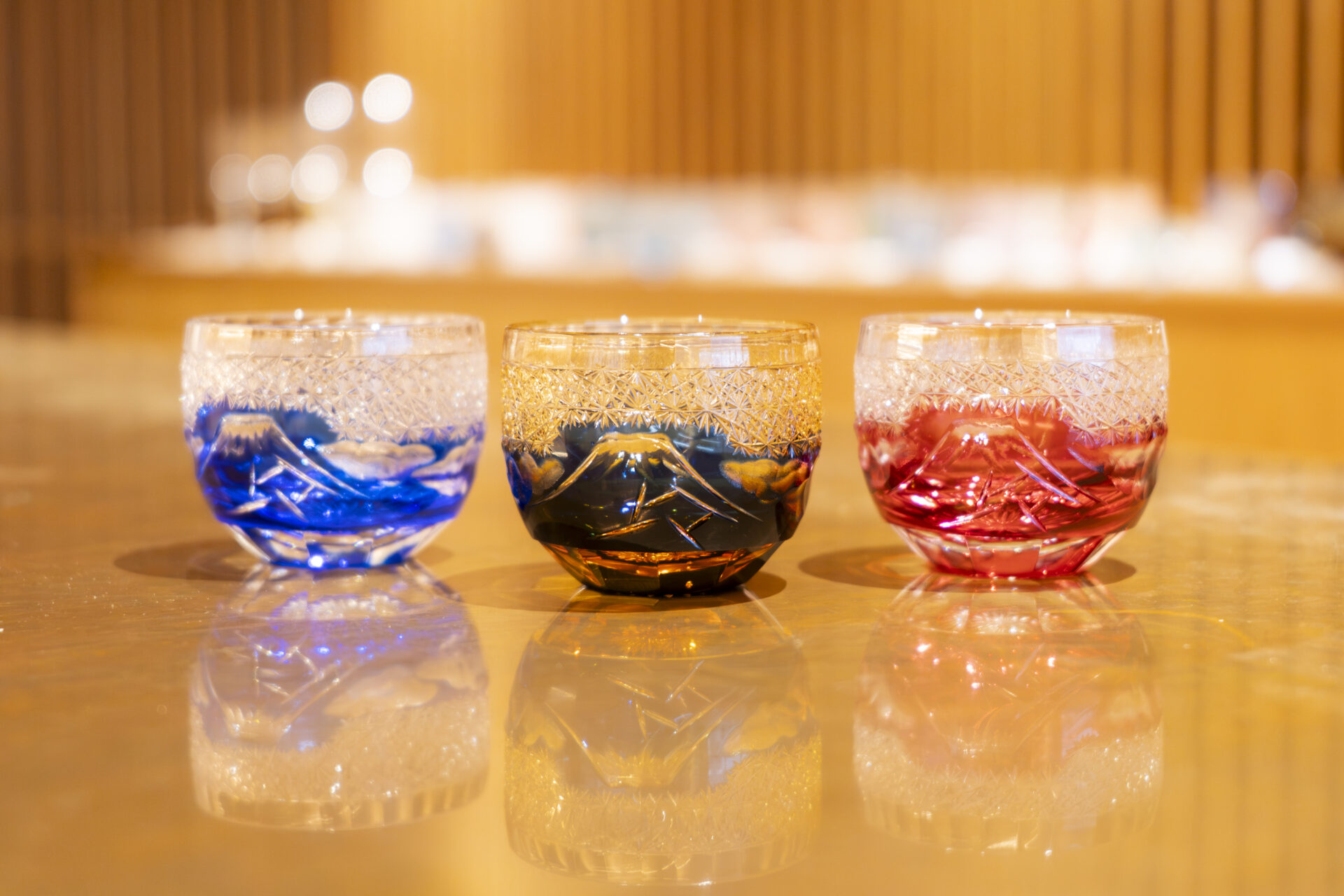
Yamada Glass “Sanka Hakuu” | Hokusai’s “Black Fuji” Reimagined in Edo Kiriko
Alongside The Great Wave off Kanagawa and Fine Wind, Clear Morning, Sanka Hakuu is one of the defining images from Katsushika Hokusai’s Thirty-six Views of Mount Fuji.
A clear sky stretches above the summit.
Below, the mountain darkens almost to black, while a sudden bolt of lightning cuts across its lower slopes.
“Sanka Hakuu” depicts a summer shower beneath Mount Fuji. With the summit still calm above the storm, the composition brings stillness and movement together in a single view.
It is also widely known as “Black Fuji.”
Yamada Glass has translated this celebrated landscape into Edo Kiriko.
What makes the piece particularly fitting is where it was created.
Hokusai was born in what is now Sumida, Tokyo.
Yamada Glass continues its craft in the same district today.
A landscape conceived nearly two centuries ago in Sumida has been reinterpreted there once again — this time through cut glass.
Calm above, a storm below
Hokusai’s Sanka Hakuu is striking for its simplicity.
The summit appears beneath a clear sky, while the lower mountain is rendered in a deep, almost black tone.
Then comes the lightning.
That contrast — between calm and turbulence, light and darkness — is central to the image.
Yamada Glass describes its own Sanka Hakuu as an interpretation of Hokusai’s work, reimagined through the language of cut glass rather than reproduced literally.
Areas of colour are left intact while other sections are cut deeply enough to reveal clear glass beneath.
Fine lines meet broader transparent surfaces.
Rather than copying a painting onto a glass, the composition translates its contrasts into colour, transparency and cut lines.
Holding “Black Fuji” in the hand
Hokusai created Sanka Hakuu as part of the Thirty-six Views of Mount Fuji series around the early 1830s.
In Yamada Glass’s version, that monumental landscape is reduced to the scale of a drinking vessel.
The official collection includes both crystal guinomi sake cups and crystal rock glasses, with several colour variations.
The design remains the same in principle, yet different combinations of coloured and clear glass change the way the mountain-like forms are perceived.
That feels especially appropriate for Sanka Hakuu.
The original work itself depends heavily on contrast.
Here, the boundary between coloured glass and the areas cut back to transparency becomes part of how the scene is experienced.
Hokusai and Yamada Glass, connected by Sumida
The choice of subject is not incidental.
Katsushika Hokusai was born in 1760 in an area that is now part of Sumida, Tokyo.
Yamada Glass also maintains its workshop in Sumida.
The studio itself explains Sanka Hakuu as a work born from this geographical connection.
It is not simply a case of choosing Hokusai because he is internationally recognisable.
Both the original image and this contemporary interpretation belong to the same part of Tokyo.
Nearly two centuries apart, two different crafts meet through the same landscape and the same city.
Three generations of cutting glass
Hari-sho Yamada Glass has passed its glass-cutting techniques through three generations over roughly eight decades.
Its practice includes both Edo Kiriko, where deeper cuts and polishing create strong geometric structures, and Hana Kiriko, which uses shallower engraving to create more pictorial designs.
The craft has been passed from founder Tomonobu Yamada to Teruo Yamada and now to third-generation artisan Masateru Yamada.
The studio describes its approach through the idea of “tradition and innovation.”
Alongside inherited patterns and techniques, it continues to create original pieces inspired by nature, landscapes and Japanese culture.
Sanka Hakuu sits naturally within that approach.
A historic image is preserved not by copying it, but by translating it into a different material and technique.
Looking at a drinking vessel as you would a picture
Once you know the original Sanka Hakuu, the glass begins to look different.
The calm summit.
The darkened mountainside.
The sudden lightning below.
Yamada Glass does not define every cut as a literal cloud, mountain or bolt of lightning.
And that is part of the appeal.
Rather than searching for an exact reproduction, the viewer can move between Hokusai’s print and the cut glass, finding connections in the contrasts of colour, line and transparency.
A woodblock print from nearly 200 years ago, and a contemporary piece of Edo Kiriko.
Sanka Hakuu invites both to be seen together.
Edo Kiriko “Sanka Hakuu” | Hari-sho Yamada Glass
Tokyo, Japan | Edo Kiriko | Crystal Glass | Yamada Glass
Inspired by Katsushika Hokusai’s Sanka Hakuu from Thirty-six Views of Mount Fuji, the piece reinterprets the celebrated “Black Fuji” through Yamada Glass’s own approach to colour and cutting.
The official range includes crystal guinomi sake cups (approx. φ60 × H50mm) and crystal rock glasses (approx. φ80 × H90mm).
For in-store product availability, please enquire at IMAMI Ginza or IMAMI Shinsaibashi, or contact us.
Product selection and availability vary by store.
New arrivals are announced on our official Instagram @imami__japan and in our NEWS archive.
Related reading
For another Yamada Glass work inspired by natural scenery, see Yamada Glass “Sazanami” Rock Glass / Kin-aka | Two Expressions of Waves in Edo Kiriko. It provides a further look at how the same workshop translates a motif into cut glass.

