



Nabetani Glass Crafts “Kokka” and “Hyoshō” | Flower, Thorn and Ice in Edo Kiriko
A flower in “Kokka,” and ice in “Hyoshō.”
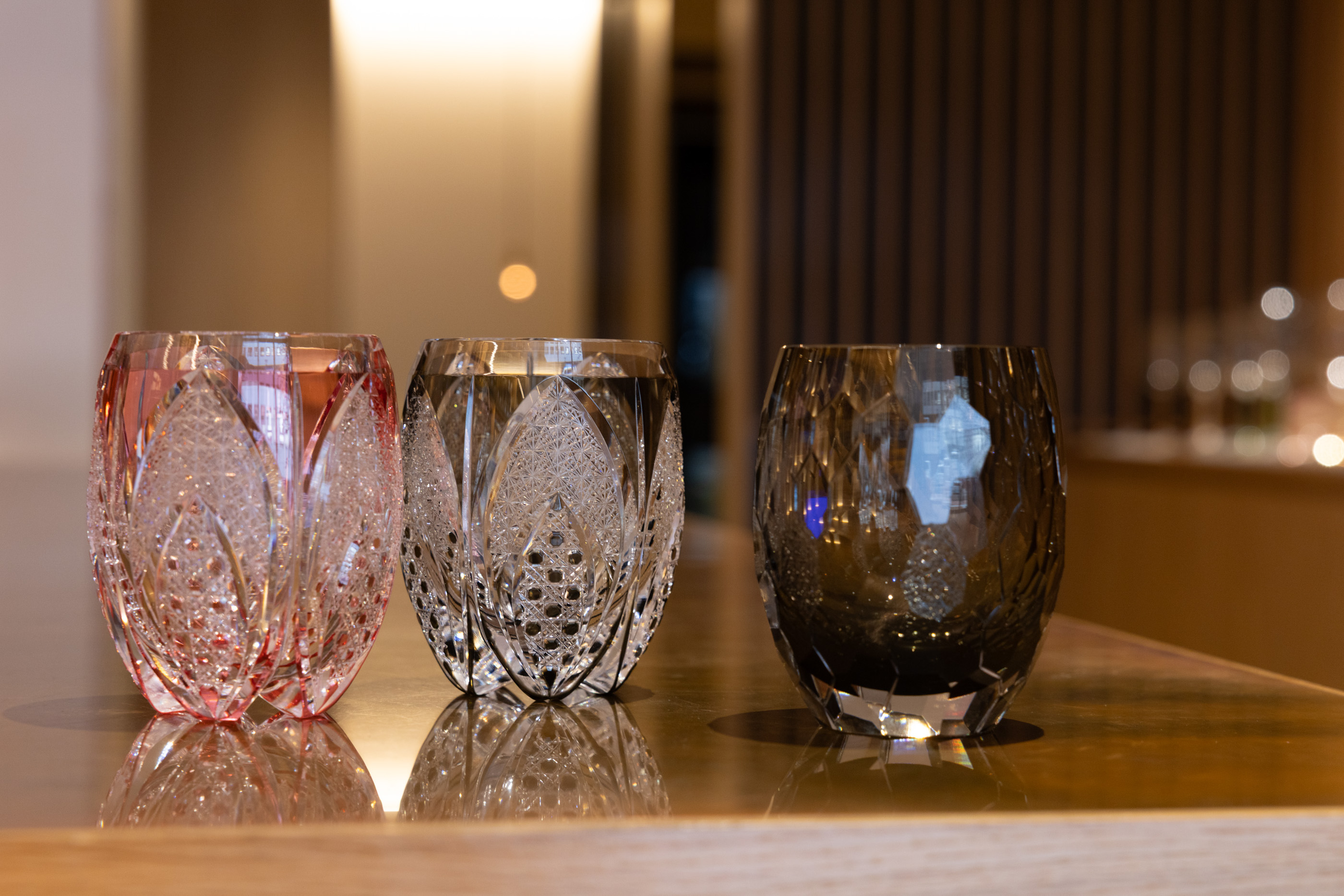
Both are Edo Kiriko works by Kaito Nabetani, the fourth-generation craftsman of Nabetani Glass Crafts in Ota, Tokyo.
They are both made from crystal glass and share nearly the same proportions: approximately 100 mm high and 70 mm in diameter.
Yet their finished expressions are very different.
Kokka uses intricate traditional patterns and bold cutting to evoke a flower and its thorns.
Hyoshō transforms the glass itself into something that feels almost like a block of ice.
Seen side by side, the two works show that Edo Kiriko is not simply about engraving patterns onto glass. Through cutting, depth and refraction, the material itself can be made to appear entirely different.
Kokka | “Every Beautiful Flower Has Its Thorn”
At the heart of Kokka is the idea:
“Every beautiful flower has its thorn.”
Kokka was also Kaito Nabetani’s first original design.
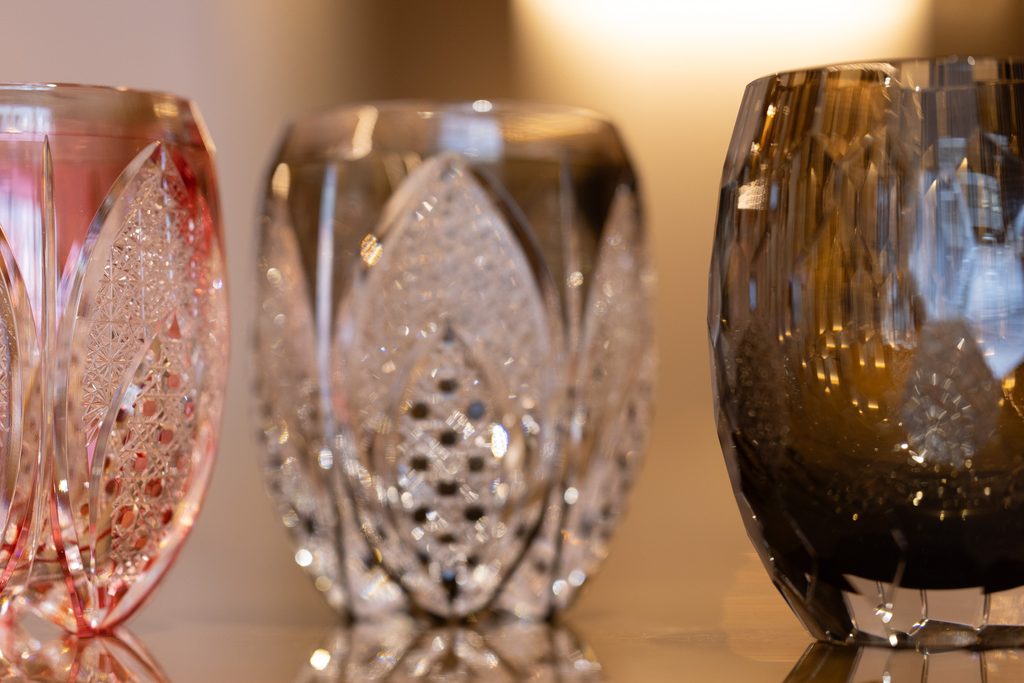
Large, overlapping leaf-like cuts frame two traditional Edo Kiriko patterns: Hakkaku Kagome, an octagonal basket-weave motif, and Kiku-tsunagi, a fine linked-chrysanthemum pattern.
The composition combines a strong, sculptural outline with extremely delicate cutting.
That contrast defines much of Kokka’s character.
A Flower and Thorn Revealed by the Viewpoint
Kokka is not fully understood from the side alone.
Look down into the glass and the overlapping cuts begin to form the image of a flower in bloom.
Cuts in the base, meanwhile, interact with refraction to create forms suggestive of thorns.
The flower and thorn are therefore not simply engraved next to one another.
They emerge through the way the glass is viewed and the way light passes through it.
Lift it. Turn it. Look into it.
Each movement reveals another part of the composition.
Kokka is an Edo Kiriko work shaped not only by pattern, but also by the thickness, depth and optical properties of the glass itself.
Hyoshō | Making Glass Look Like Ice
Hyoshō, meaning “ice crystals,” begins with a very different idea.
Broadly cut surfaces resemble solid pieces of ice.
Fine lines run between them like fractures.
Within those larger cuts, the traditional Kiku-tsunagi pattern appears again, this time suggesting smaller crystalline formations within the ice.
Large facets create the mass of ice.
Fine cuts create the crystals within it.
By combining those two scales, Hyoshō builds an entire frozen landscape within a single glass.
Inner-Overlay Glass and Colour Beneath the Surface
One of the most distinctive technical features of Hyoshō is its use of inner-overlay glass, or uchikabuse.
In more conventional coloured overlay glass, the coloured layer sits on the outside of clear glass and is gradually removed as the surface is cut.
Hyoshō reverses that structure.
The coloured glass is placed on the inside of the clear crystal.
This means that even when the exterior is cut deeply, the colour beneath remains.
The result is a transparent cut surface with colour still visible deeper inside the glass.
That construction creates the impression that colour has been sealed within a block of ice.
Nabetani has explained that this inner-overlay technique allows the colour to remain visible even after extensive cutting, making it possible to use depth without sacrificing the underlying tone.
In Hyoshō, the colour is not carved away to create the pattern.
The clear glass is cut so that the colour behind it can be seen.
That is one of the features that distinguishes it from more conventional Edo Kiriko.
Cutting by Looking at the Individual Glass
Hyoshō is also notable for the way some of its crack-like lines are placed.
The broad facets are created first.
After that, Nabetani studies the individual piece and decides where the fine, fractured lines should run.
Rather than following one completely fixed drawing, he has described responding to the shape of the glass itself and placing cuts where they appear most balanced and effective.
What looks like a naturally fractured piece of ice is therefore not accidental.
It sits between two approaches:
the precision of traditional Edo Kiriko, and the individual judgement of the craftsman.
Kokka Changes with the Viewpoint. Hyoshō Changes the Material Itself.
Kokka and Hyoshō share several characteristics.
Substantial crystal glass.
Deep, assertive cutting.
Traditional patterns such as Hakkaku Kagome and Kiku-tsunagi.
But those techniques are used for different purposes.
Kokka reveals its flower and thorns as the viewpoint changes.
Hyoshō uses deep cuts and inner-overlay glass to make crystal appear like ice.
One transforms through light and perspective.
The other transforms through the structure of the material itself.
The fact that the same craftsman can create such different impressions from the same basic material is what makes the two works especially interesting together.
Edo Kiriko by Fourth-Generation Craftsman Kaito Nabetani
Nabetani Glass Crafts was established in 1949 in Ota, Tokyo.
Today, production continues under third-generation traditional craftsman Junichi Nabetani and fourth-generation craftsman Kaito Nabetani.
Kaito was born in 1994.
He joined Kagami Crystal in 2016 before entering Nabetani Glass Crafts in 2018.
He later received Gold Prizes in the tableware category of the Edo Kiriko New Works Exhibition for three consecutive years from 2021 to 2023.
The workshop’s approach is not limited to preserving inherited forms.
Its work explores glass that is thicker, deeper and more sharply cut, carrying traditional technique into a more contemporary expression.
Kokka and Hyoshō make that philosophy easy to see.
Traditional motifs remain.
But the finished works are not reproductions of older Edo Kiriko.
Inherited technique is being used to create a present-day expression.
Kokka and Hyoshō are two different answers to that idea.
Nabetani Glass Crafts “Kokka” / “Hyoshō”
Tokyo, Japan | Edo Kiriko | Old-Fashioned Glass | Crystal Glass
Kokka is built around the idea that every beautiful flower has its thorn, using Hakkaku Kagome, Kiku-tsunagi and optical refraction to reveal flower and thorn through changing viewpoints.
Hyoshō uses deep cuts and inner-overlay glass to evoke the appearance of ice crystals.
For pricing, current availability, and purchase enquiries, please feel free to contact us.
New arrivals are announced on our official Instagram @imami__japan and in our NEWS archive

