



Satoshi Nabetani “Koka” | Clear and Aozumi Edo Kiriko
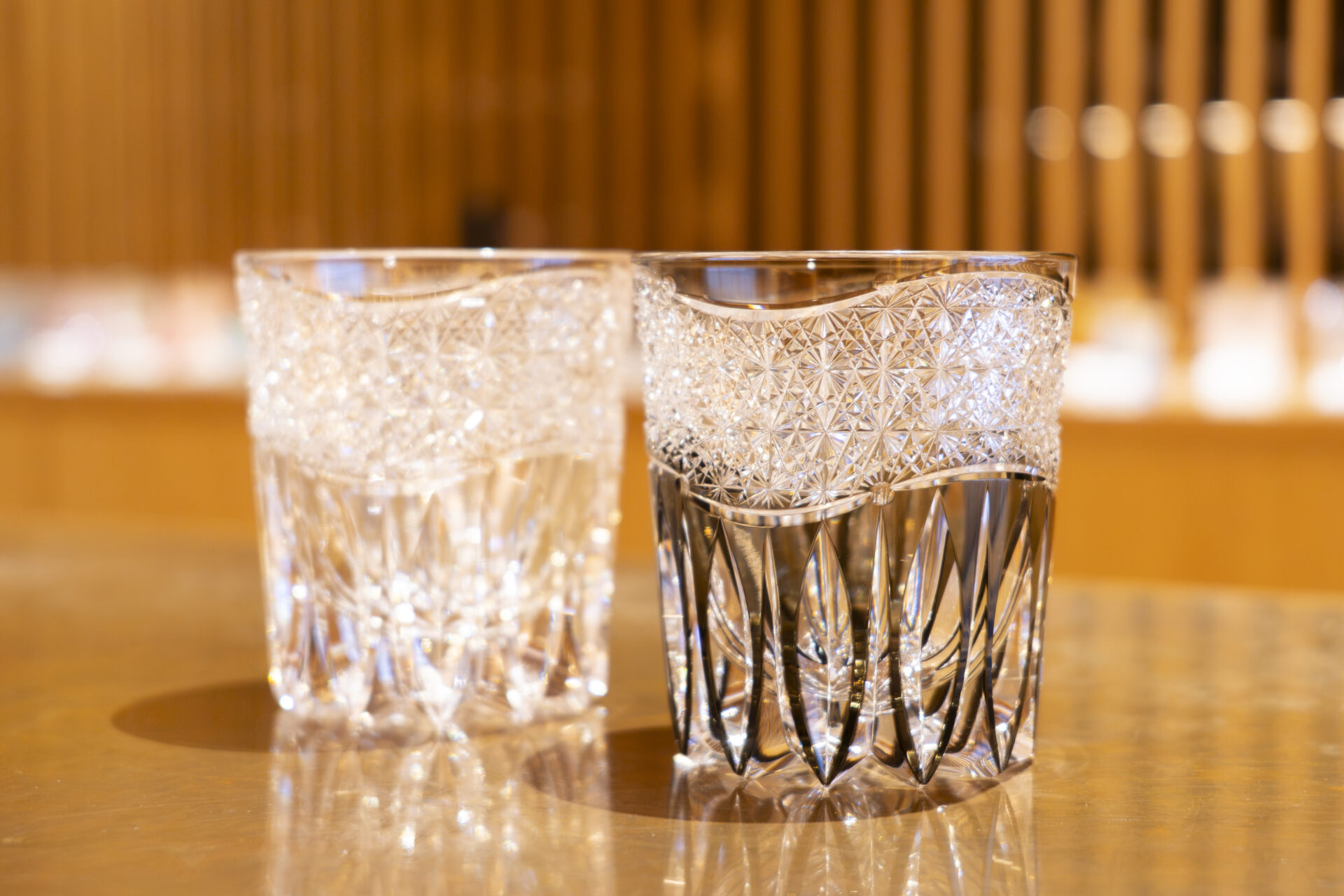
The same cut design can look remarkably different in clear crystal and deep blue-black glass.
“Koka” (光華) by Satoshi Nabetani of Toa Glass Crafts is an Edo Kiriko rocks glass built around densely layered cuts and the way those cuts redirect light.
This article presents two colourways: Clear and Aozumi (青墨), a deep blue-black version. The Japanese colour name Aozumi is retained here as the product name; “blue-black” is simply a practical English description of its appearance.
“Koka” received an Edo Kiriko award in 2009
Satoshi Nabetani is the second-generation head of Toa Glass Crafts, a Tokyo workshop founded in 1960. He was officially certified as a Traditional Craftsperson for Edo Kiriko in 2010.
One year earlier, a work titled “Koka” received the Cooperative Chairman’s Award at the 21st Edo Kiriko New Works Exhibition in 2009.
The workshop describes its continuing focus as the pursuit of light — using precise, smooth cutting to create different optical effects in glass.
What is Edo Kiriko?
Edo Kiriko is a traditional Japanese cut-glass craft associated with Tokyo. Patterns are created by pressing glass against rotating cutting wheels, then refining and polishing the cut surfaces. The craft was officially designated a Traditional Craft by the Japanese government in 2002.
One of the defining cuts used on “Koka” is kiku-tsunagi (菊つなぎ), a traditional Edo Kiriko pattern whose name can be rendered as “linked chrysanthemums.” KAGAMI has previously exhibited the work under the title “Old Glass Koka (Kiku-tsunagi).”
Kiku-tsunagi is built from many fine intersecting lines that form repeating chrysanthemum-like geometry. On “Koka,” those dense cuts divide reflected light into numerous small points that shift as the glass is turned.
Clear: the cut itself becomes the colour
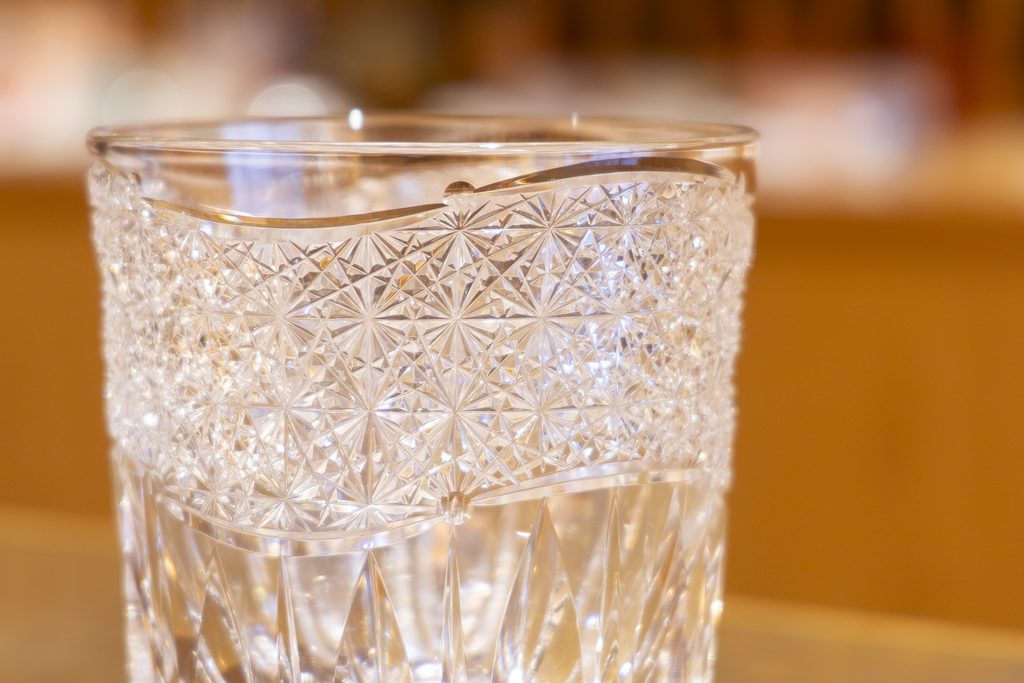
The Clear version uses transparent crystal without a coloured outer layer.
With no strong colour competing for attention, the depth, intersections and refraction of the cuts become easier to see. The glass also takes on the colours of its surroundings, so the appearance changes with the table, the room and the drink inside it.
In this version, transparency is not an absence of decoration. It makes the behaviour of light itself more visible.
Aozumi: light appears through contrast
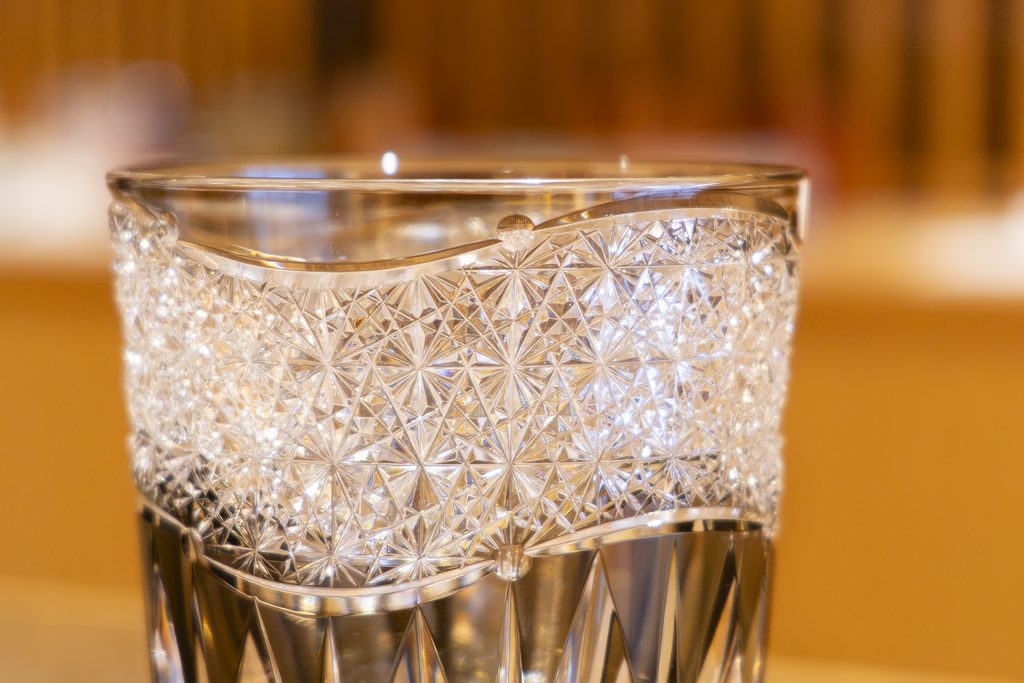
Aozumi (青墨) is the name used for the deep blue-black colourway.
It is made in a coloured-over-clear style: cutting through the darker surface layer reveals transparent crystal beneath. The design therefore gains a strong contrast between dark colour and clear cut surfaces.
Viewed directly, the vessel can appear restrained and almost black-blue. Under stronger light, the transparent cuts become much brighter and more graphic.
The Clear version disperses light across an entirely transparent surface; Aozumi makes that light easier to read against a dark field. The pattern is the same, but the visual experience is not.
A workshop founded in Tokyo in 1960
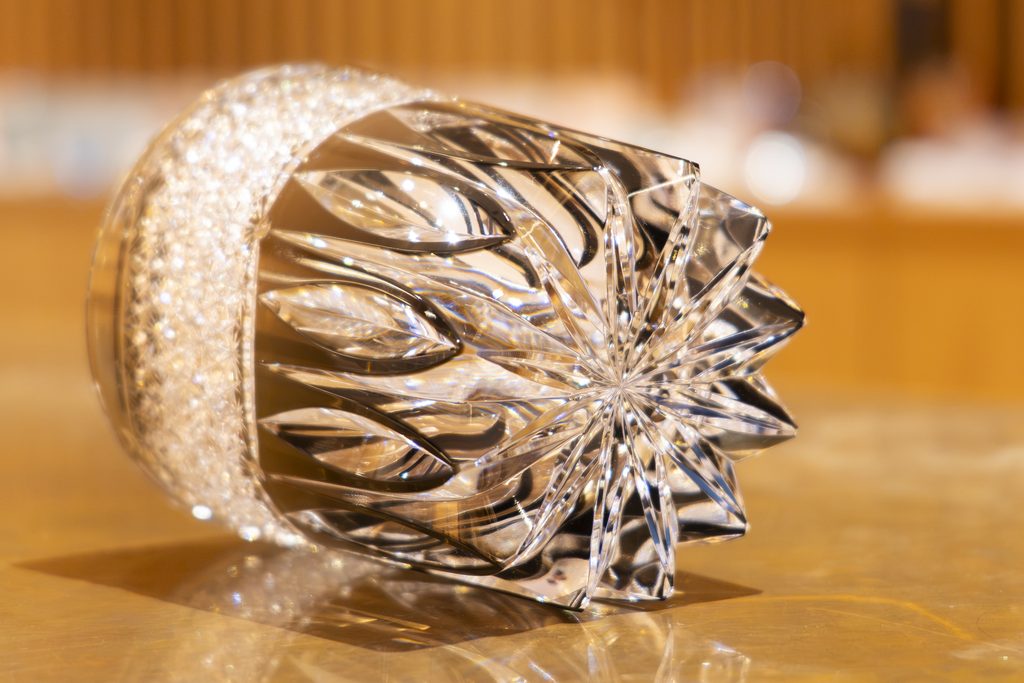
Toa Glass Crafts was founded in Kamata, Ota Ward, Tokyo, in 1960.
The workshop originally worked extensively in industrial glass cutting, including whisky bottles, and trained a large number of craftspeople before developing its work in Edo Kiriko.
Today, under Satoshi Nabetani, the workshop combines traditional cutting skills with an ongoing interest in transparency and light.
Why the two versions are worth seeing together
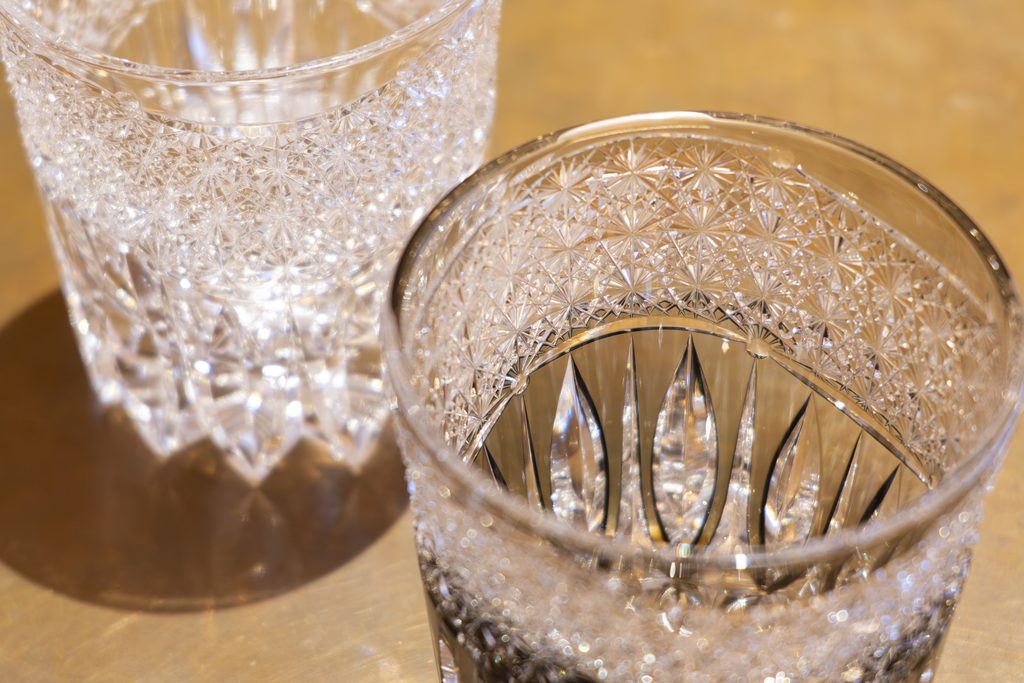
Clear and Aozumi are not two different patterns.
They show how colour changes the behaviour of the same cuts. Clear absorbs the colours and reflections around it; Aozumi frames the transparent cuts against a dark blue-black surface.
Seen side by side, they make one principle of Edo Kiriko especially easy to understand: colour is not simply added decoration. It changes how the cut glass receives, reflects and reveals light.
Toa Glass Crafts “Koka” Rocks Glass
Japan | Edo Kiriko cut glass | Toa Glass Crafts | Satoshi Nabetani | Crystal glass | Rocks glass | Clear and Aozumi
Awarded under the name “Koka” in the 2009 Edo Kiriko New Works Exhibition, the design uses dense cutting to fragment light across the glass. Clear presents that effect through transparency; Aozumi through the contrast between deep colour and exposed crystal.
Available at IMAMI
IMAMI is a specialist retailer offering wine, whisky, sake and other fine spirits, together with Japanese drinking vessels including Edo Kiriko glassware. We carefully select and sell each bottle and piece with attention to the craftsmanship, history and culture behind it.
For in-store product availability, please enquire at IMAMI Ginza or IMAMI Shinsaibashi, or contact us.
Product selection and availability vary by store.
New arrivals are announced on our official Instagram @imami__japan and in our NEWS archive.
