



Shinozaki Glass Kiku Kagome Guinomi | Edo Kiriko Latticework with Chrysanthemum-Like Brilliance
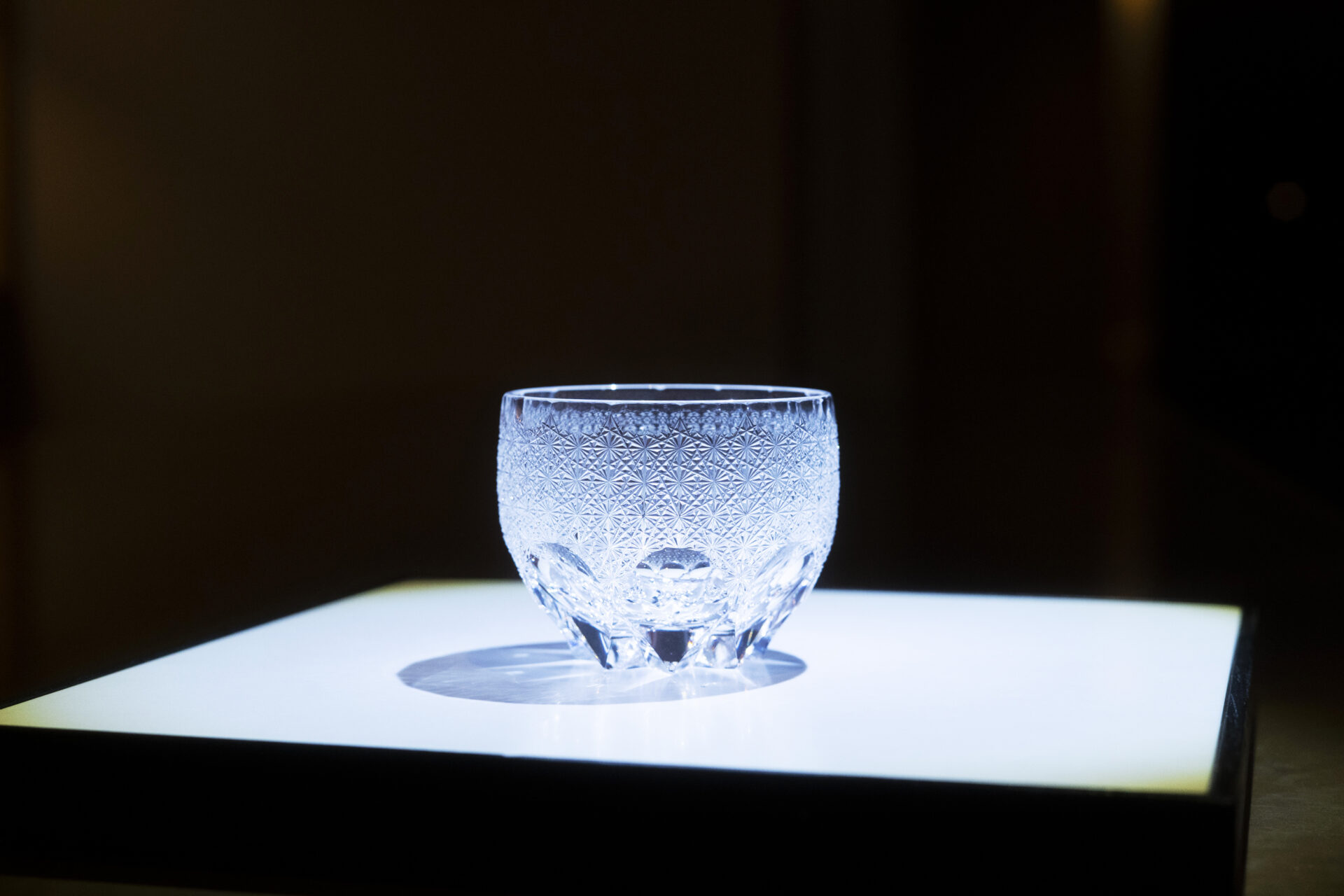
Layers of fine kagome cuts intersect across the glass, creating a brilliance that recalls a chrysanthemum in bloom.
Shinozaki Glass “Kiku Kagome” Guinomi is an Edo Kiriko sake cup crafted by Shinozaki Glass.
Its clear crystal surface is covered with the intricate Kiku Kagome pattern. Rather than relying on the contrast of colored overlay glass, this piece draws its character from the transparency of the crystal itself and the way each cut refracts light.
Shinozaki Glass|An Edo Kiriko workshop founded in 1957
Shinozaki Glass was founded in 1957 by Seiichi Shinozaki as a specialist Edo Kiriko workshop.
Today, the atelier continues under Hideaki Shinozaki, combining traditional motifs such as kagome and kiku-tsunagi with careful consideration of how light reflects through and across the glass.
The appeal of Shinozaki Glass lies not only in the precision of its cutting, but also in the way each pattern is designed to transform when viewed from different angles.
Kiku Kagome|Geometric latticework with a chrysanthemum-like brilliance
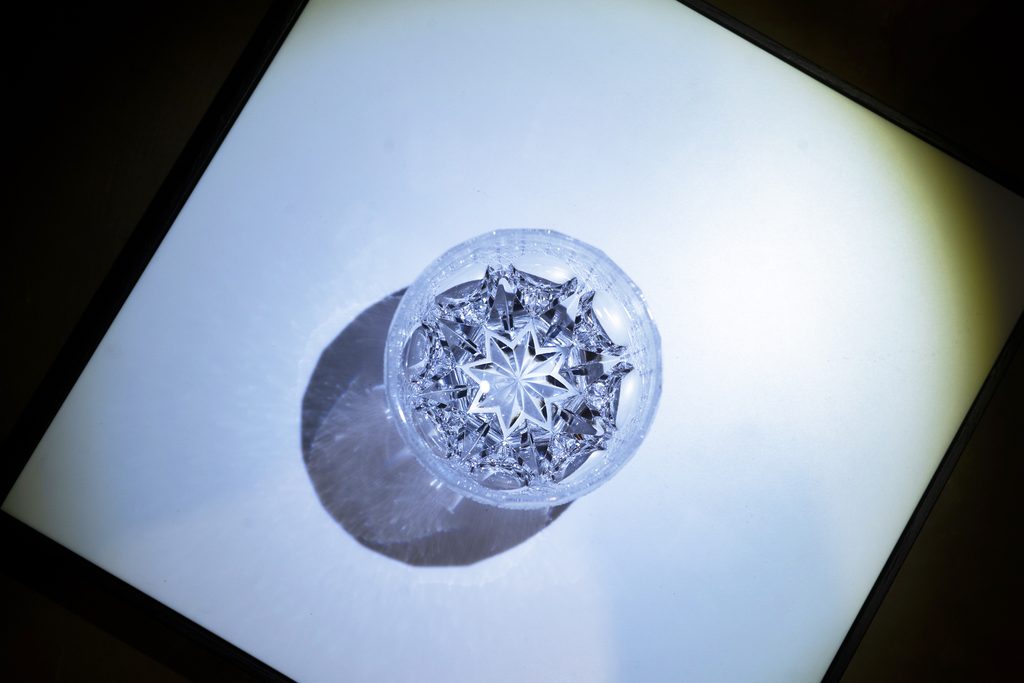
The name Kiku Kagome refers to a pattern built from the fine intersecting geometry of kagome latticework, arranged to create a radiating, chrysanthemum-like impression.
Kagome is a traditional Japanese geometric motif. In Edo Kiriko, its closely spaced lines create a dense network of reflections across the surface of the glass.
In this piece, the pattern extends across the entire cup, and the overlapping cuts produce flashes of light that shift as the vessel moves in the hand.
Clear crystal that places the cutting itself at the center
This version is crafted from clear crystal glass.
Colored Edo Kiriko often gains much of its visual impact from the contrast between a colored outer layer and the transparent glass beneath. In clear crystal, by contrast, the depth, spacing and accuracy of the cutting become immediately visible.
As light enters the glass, each line catches and redirects it toward the surrounding cuts. With no color to dominate the eye, the craftsmanship itself becomes the defining feature.
Changing density of light in the palm of the hand
The Kiku Kagome guinomi is designed to be appreciated in motion as much as from a fixed viewpoint.
A slight turn of the cup changes where the light gathers. Some parts of the pattern flare brightly while others fall back into shadow, giving the surface a continuously changing depth.
This shifting balance of light is one of the most distinctive aspects of the piece.
A second expression once sake is poured
The cup measures approximately 62 mm in diameter and 50 mm in height, with a capacity of around 90 ml.
Once clear sake is poured, the liquid, crystal and fine Kiku Kagome cuts begin to overlap visually, creating a greater sense of depth than when the vessel is empty.
The reflections extend inward through the sake, giving the cup a more three-dimensional brilliance. It is a piece designed not only for drinking, but also for appreciating the interplay of light, glass and Japanese craftsmanship.
Shinozaki Glass “Kiku Kagome” Guinomi
Japan|Edo Kiriko|Shinozaki Glass|Guinomi|Kiku Kagome|Crystal Glass|Approx. 62 mm Diameter|Approx. 50 mm Height|Approx. 90 ml
Built from the precise geometry of kagome and arranged to create a chrysanthemum-like brilliance, Kiku Kagome is a pattern that reveals itself through light. In clear crystal, the precision of the cutting becomes the central expression of this Edo Kiriko sake cup.
Available at IMAMI
IMAMI is a specialty retailer offering fine wine, whisky and sake alongside Japanese drinking vessels and traditional crafts including Edo Kiriko. For current availability, please visit IMAMI Ginza, IMAMI Shinsaibashi, or contact us.
Please note that, as each piece is handcrafted, individual variations may occur and stock availability may change.

